Your watch estimates your zones. A laboratory VO₂ Max test measures them — and measures one of the strongest markers of fitness and long-term health while it's at it.
VO₂ Max is the maximum rate at which your body can take in and use oxygen. It sets the ceiling on every hard session you do — and it's one of the strongest predictors of healthspan we can measure.
Most people training with heart-rate zones have never measured the number those zones are built on. Age-predicted formulas (like 220 minus age) are estimates and can be well out for an individual, and a smartwatch number is a useful estimate and a good way to track trends. If you're doing structured intervals, chasing a time, or training seriously for the long game, a test gives you your own numbers to train from.
One test gives you your physiology, not an estimate.
VO₂ Max or VO₂ Peak? VO₂ Max is an all-out test to exhaustion, best suited to trained athletes who regularly work at maximal effort. A VO₂ Peak test is a graded clinical test that stops at your peak — safe for the general population, including people with health conditions — and it still gives you your own heart-rate training zones. An Accredited Exercise Physiologist screens you first and selects the right protocol for you. Ask us if you're unsure.
Set training zones off your measured thresholds. Pace intervals with intent, and retest to see what the block changed.
Repeated high-intensity efforts live and die on aerobic capacity. Find out what yours actually is.
Aerobic capacity falls 3–6% per decade through your 20s and 30s, and the decline accelerates to more than 20% per decade in your 70s. The higher you start, the longer you stay above the line. Measure it, then build the reserve.
Planning consistent Zone 5 work with us? Testing comes first — we establish your safe, measured ceiling before prescribing anything near it.
ADF, WA Police, DFES and similar physical entry standards all reward one thing: a bigger aerobic engine. There's no single VO₂ Max cut-off to hit — but the fitter you are, the more comfortably you clear every threshold on the day. Test to find your starting point, target the gaps, and retest before assessment so you walk in knowing rather than hoping.
VO₂ Max isn’t just a performance number. It’s one of the strongest predictors of long-term health we can measure — and unlike most risk factors, it’s one you can change.
In 2018, Cleveland Clinic researchers tracked long-term mortality in more than 122,000 people who’d completed a treadmill test (average age 53). After adjusting for age, sex and existing conditions, the pattern was hard to ignore:
The point isn’t to alarm you. It’s that cardiorespiratory fitness is a modifiable risk factor — arguably the most modifiable one on that list. And every step up counts: across 33 studies, each 1-MET higher level of fitness (roughly jogging 1 km/h faster) was linked to about 13% lower risk of death from any cause. You don’t have to be elite to benefit — you have to be less unfit. Measuring where you sit is where that starts.
Sources: Mandsager K et al., JAMA Network Open 2018 (122,007 adults, median follow-up 8.4 years; risk-adjusted hazard ratios). Kodama S et al., JAMA 2009 (meta-analysis of 33 studies, ~103,000 people). These are population-level associations from observational research: they show how strongly fitness relates to long-term health, not a prediction for any one person or a guarantee from any single test or program.
Aerobic capacity fades with age — typically 3–6% per decade through your 20s and 30s, accelerating to more than 20% per decade in your 70s and beyond. And it's lost in steps, not a smooth curve: ten days of bed rest cost healthy adults in their late 60s around 12% of their aerobic capacity. The decline itself runs regardless of how active you are — which is exactly why your starting point matters so much. Everyday life has a fitness floor: climbing stairs, carrying shopping, getting up off the floor each demand a certain VO₂, and the higher you sit above that floor, the more decades of margin you have before ordinary tasks become hard. Training raises the starting point at any age — previously sedentary adults over 60 improve VO₂ by around 16% with structured endurance work — and strength training protects the muscle that converts oxygen into movement. The chart maps fitness against age, with the VO₂ needed for everyday tasks marked alongside, so you can see your margin and what it would take to widen it.
A high-fitness 75-year-old still has the aerobic capacity to climb stairs briskly. A low-fitness 75-year-old is near the threshold for walking up a gentle incline. That’s what healthspan actually means — staying above the line for the things you want to keep doing.
Data sources: ACSM’s Guidelines for Exercise Testing and Prescription (chart rebuilt from published fitness norms; lines are illustrative). Decline rates: Fleg JL et al., Circulation 2005 (Baltimore Longitudinal Study of Aging). Bed-rest effect: Kortebein P et al., J Gerontol A 2008.
Your VO₂ Max test shows where you sit on these charts today and gives you your projection — then we work on changing it.
The test maps your individual response across the full intensity range — including the thresholds where your physiology actually shifts. Your zones come off that data, not a formula.
Most of your training volume belongs in Zone 2 — but your ceiling is set in Zone 5. Testing gives you both.
A measured maximum means your Zone 5 work is dosed precisely to push your VO₂ Max up — and it anchors every zone below it, so you always know which energy system a session is training.
Zone 2 is where it matters most. Sit too low and the stimulus isn't there. Drift too high and you're quietly working anaerobically, accumulating fatigue without building the base. Measured zones let you hold true Zone 2 and progressively overload it — session after session, block after block.
Exercise, clinically dosed — the right intensity, in the right zone, for the adaptation you're actually chasing.
Aerobic capacity is modifiable at any age, and the evidence on how much — and how — is clearer than most people expect.
VO₂ gain in previously sedentary adults aged 60+ with endurance training — about 3.8 mL/kg/min, roughly one MET. (Huang et al., 2005; 41 trials.)
Of death from any cause for every 1-MET higher level of fitness — about jogging 1 km/h faster. (Kodama et al., JAMA 2009.)
The biggest gains in older adults came at about 60–70% of VO₂ Max — comfortably working, full sentences, slightly breathless. Consistency over months matters more than intensity on any one day.
Check first: if you have a heart, lung or metabolic condition, chest pain or dizziness with exertion, or you're new to exercise, see your GP or an Accredited Exercise Physiologist before starting — that's exactly what our screening is for. Retest at around 12 weeks to see your numbers move.
Resting heart rate, blood pressure and health screen with an Accredited Exercise Physiologist — the same clinical standard we apply to every client.
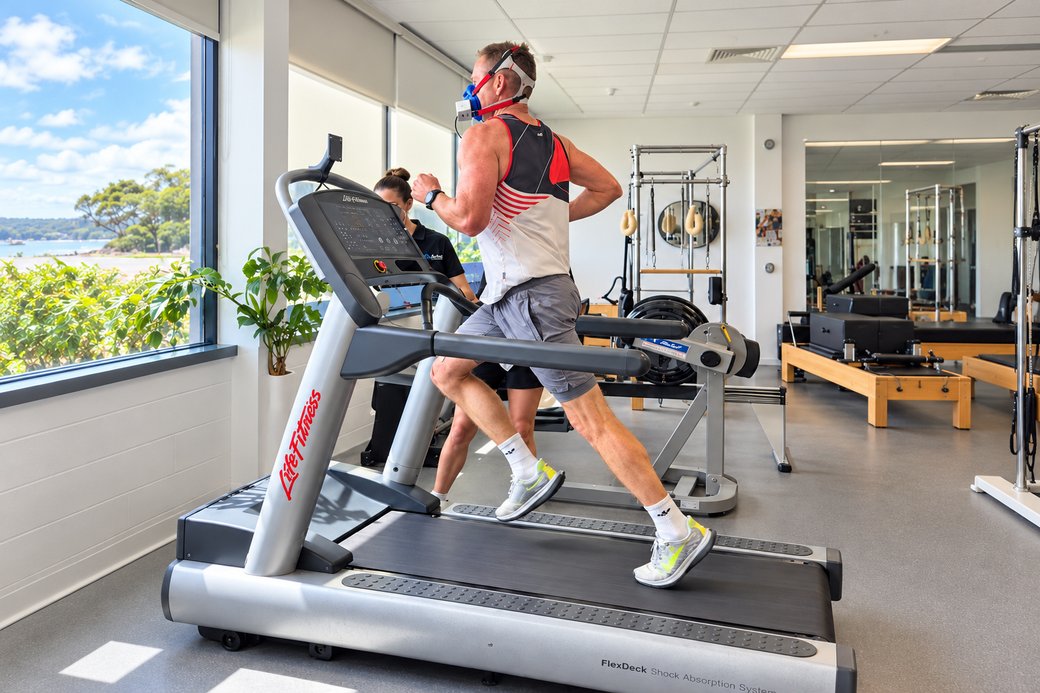
Treadmill or bike, wearing a mask that measures every breath. Intensity builds gradually while we track oxygen uptake, heart rate and your response in real time.
You work to a true maximal effort while your heart rate, blood pressure and response are monitored throughout. If anything warrants stopping early, we see it and act on it. That's the difference between a lab test and a field guess.
Your VO₂ Max, measured thresholds and training zones, explained properly — plus what to do with them. Report to you, and to your GP or specialist if you want it sent.
Allow around 60 minutes. Come rested, fuelled, and ready to work hard for 8–12 of them.
Coaches, sports physios and parents: we frame athlete testing around capability, not appearance, screen for low energy availability (RED-S), and write reports that support your guidance rather than override it. Read how we test athletes safely — and build performance from multiple data points →
Plenty of places can strap a mask on you. The difference is what's behind the numbers.
The same testing rigour we bring to cardiac patients, applied to your performance. That's not a slogan — it's the same equipment, the same clinicians, the same standards.
VO₂ Max testing packages start from $250 — including the full test, measured training zones, written report and debrief.
Report to your GP or specialist included on request.
Wrist-based estimates are derived from heart rate and pace algorithms, not measured gas exchange. Studies consistently show errors of 5–15% either way — enough to put your training zones in the wrong band entirely. A laboratory test measures your actual oxygen uptake, breath by breath.
Norms vary by age and sex — as a guide, higher values sit in progressively smaller percentiles of the population, and aerobic capacity declines with age — typically 3–6% per decade in your 20s and 30s, accelerating later in life without deliberate training. Your report benchmarks your result against age- and sex-matched norms and shows exactly where you sit.
Yes. Entry assessments like the ADF pre-entry fitness assessment, WA Police physical performance evaluation and DFES firefighter testing all draw heavily on aerobic capacity. A VO₂ Max test shows exactly where your engine sits now, we translate that into a targeted training block, and a retest before assessment day confirms you're ready.
No referral needed — anyone can book. If you have a heart condition or other medical history, our screening process identifies anything that needs GP or specialist input first, and we handle that communication for you.
No hard training for 48 hours before the test. Fuel as you would for a hard session, and avoid caffeine for a few hours beforehand. Bring your usual training shoes. Allow around 60 minutes.
Testing is conducted at our North Fremantle flagship clinic — 1/124 Stirling Hwy, North Fremantle WA 6159 — servicing Fremantle, Cottesloe, Claremont and the wider Perth area.
Our VO₂ Max testing packages start from $250 including GST, covering the full graded test, measured training zones, a written report and a results debrief with an Accredited Exercise Physiologist.
