Premium, individually prescribed Phase 3 cardiac rehab — testing-led, closely monitored, and reported to your treating team.
Hospital-based cardiac rehabilitation (Phase 2) usually runs for six to twelve weeks. Then the structured support stops — often at exactly the point where the early gains need to be consolidated and built on, and where many people quietly drift away from exercise. Our program is the ongoing clinical bridge: a Phase 3 service of individually prescribed, closely supervised exercise that rebuilds measured fitness and function, safely, for the long term.
It is a referral-led, one-to-one clinical service — not a general gym program — delivered at our North Fremantle flagship clinic and overseen in partnership with our cardiac advisor, Professor Steve Selig.
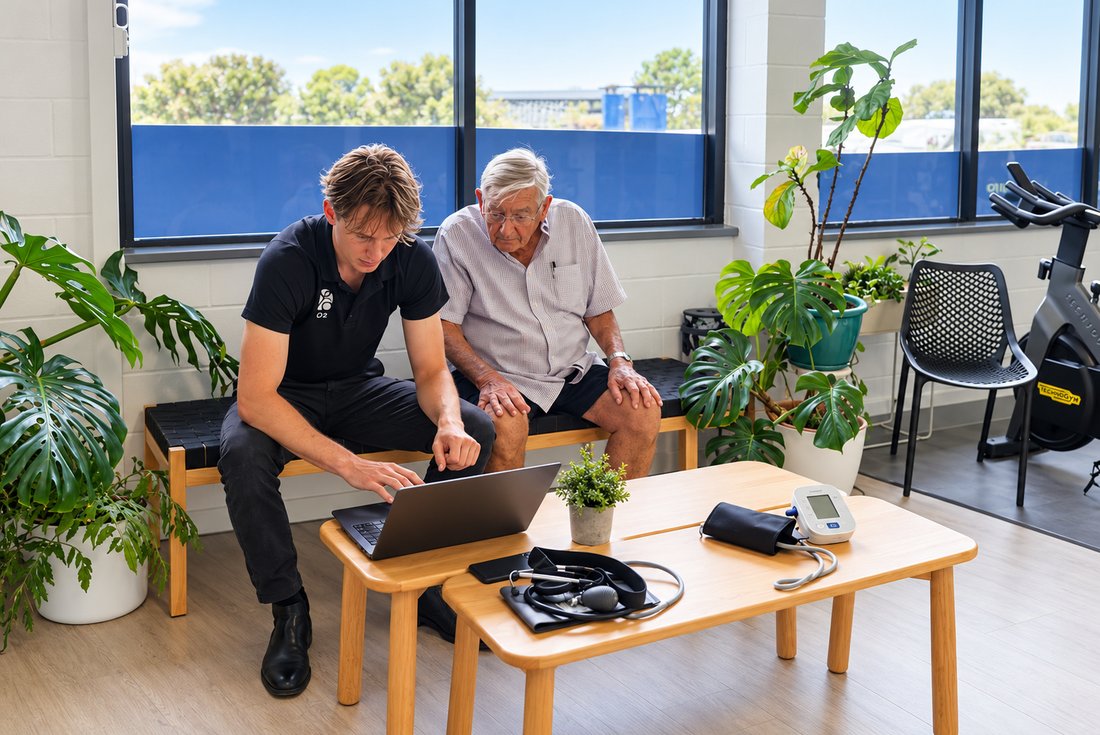
We take medical referrals for people who want to keep going — safely — after their initial cardiac care.
Continuing on from hospital or community cardiac rehabilitation, so hard-won fitness isn't lost.
Following a heart attack, CABG, stents (PCI), valve surgery, or a new diagnosis of heart failure.
Atrial fibrillation and other arrhythmias, pacemakers and ICDs, and people on medications that make heart rate an unreliable guide.
Most exercise prescription after a cardiac event relies on a six-minute walk test or a heart-rate target. We don't. Every program starts with a sign-, symptom- and fatigue-limited incremental exercise test to estimate your VO₂ Peak — your true, safe exercise capacity — on a treadmill, bike, arm ergometer or step, whichever suits you.
From that test we set the exact intensities your program is prescribed at, governed by VO₂ percentage, rating of perceived exertion (RPE) and symptoms — not heart rate. That matters: in atrial fibrillation, with a pacemaker, or on beta-blockade, heart rate is an unreliable guide to effort, and a heart-rate target can be either unsafe or pointlessly cautious.
The testing and prescription protocol is built with Professor Steve Selig, one of Australia's most senior clinical exercise physiologists, using established workload-based methods to estimate VO₂ Peak.
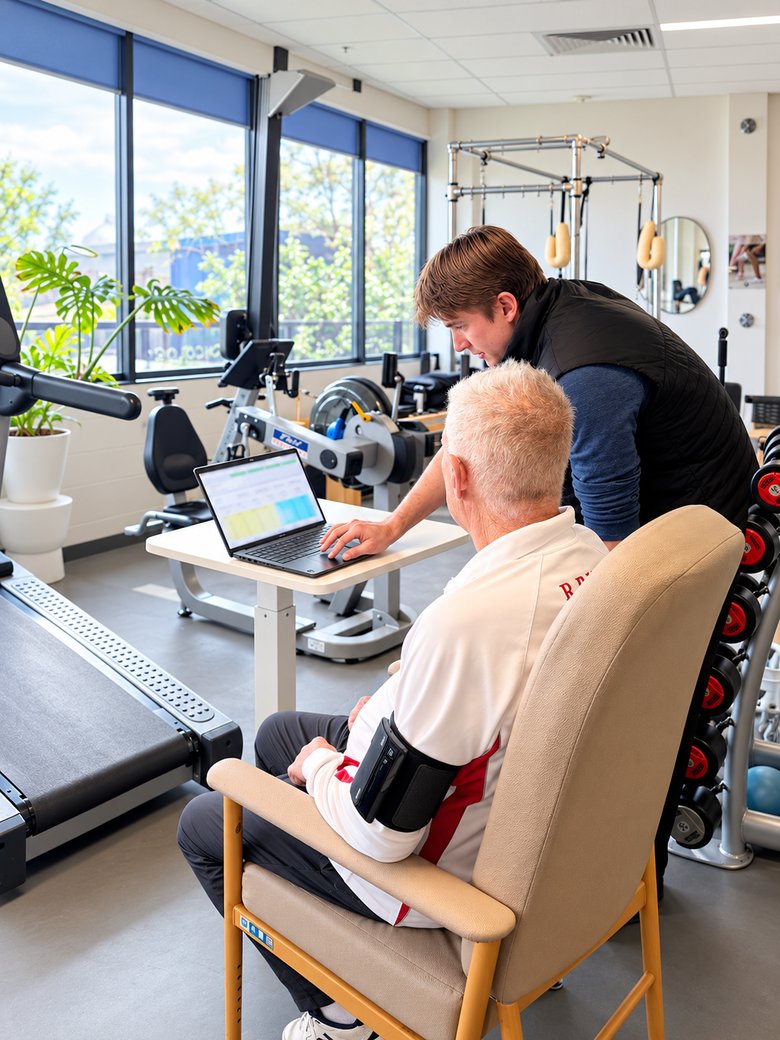
An initial assessment (around 90 minutes) reviews your history, diagnoses, medications and goals, then a clinically supervised, symptom-limited exercise test with monitored recovery.
Your exercise physiologist builds an individualised plan from your results and writes to your cardiologist and GP, setting out the baseline and the approach.
One-to-one supervised sessions, progressed conservatively within your tested limits — stepping down to cardiac classes or supervised gym as you safely self-manage.
Scheduled reassessment (typically at 6–12 months), with a progress letter to your treating team so the gains are measured, not assumed.
Cardiorespiratory fitness — your VO₂ Peak — is one of the strongest predictors of long-term health. In a large study of adults undergoing exercise testing, the least-fit had around five times the risk of death from any cause compared with the fittest — a larger difference than that associated with coronary artery disease, diabetes or smoking. Improving fitness is, in turn, associated with better oxygen transport, fewer repeat hospitalisations, lower cardiovascular mortality and better quality of life.
That's why we measure it, prescribe to it, and re-measure it — so the thing that matters most is the thing we're actually moving.
Fitness–mortality association: Mandsager et al., JAMA Network Open, 2018 (risk-adjusted hazard ratio ~5.0 for least-fit vs elite fitness). Exercise physiology complements, and does not replace, your medical care; individual results vary.
We welcome referrals from cardiologists, GPs, Phase 2 programs and other treating health professionals. There's no complex form to complete: give your patient a copy of your existing clinic letter and ask them to contact us directly, bringing that letter and any relevant echo, CT or stress-test reports. Medication and device details can come from the GP care plan or the patient's device card.
You'll receive a concise baseline summary after assessment and a progress letter at review — the clinically significant information you need, without the noise. We're glad to adjust our approach to fit your management of the patient.
Refer a patient for Phase 3 cardiac rehabilitation, or get in touch to discuss whether the program is the right fit.
