Advanced physiological testing, delivered by Accredited Exercise Physiologists and translated into personalised programs for better health, function and long-term performance.
Objective testing is the difference between a program that should work and a program you can see is working. O2 Active offers a suite of clinical-grade assessments you'd normally have to visit a specialist facility or university lab to access.
Testing is available as a standalone service, including on GP or specialist referral, or as the foundation of any O2 Active program.
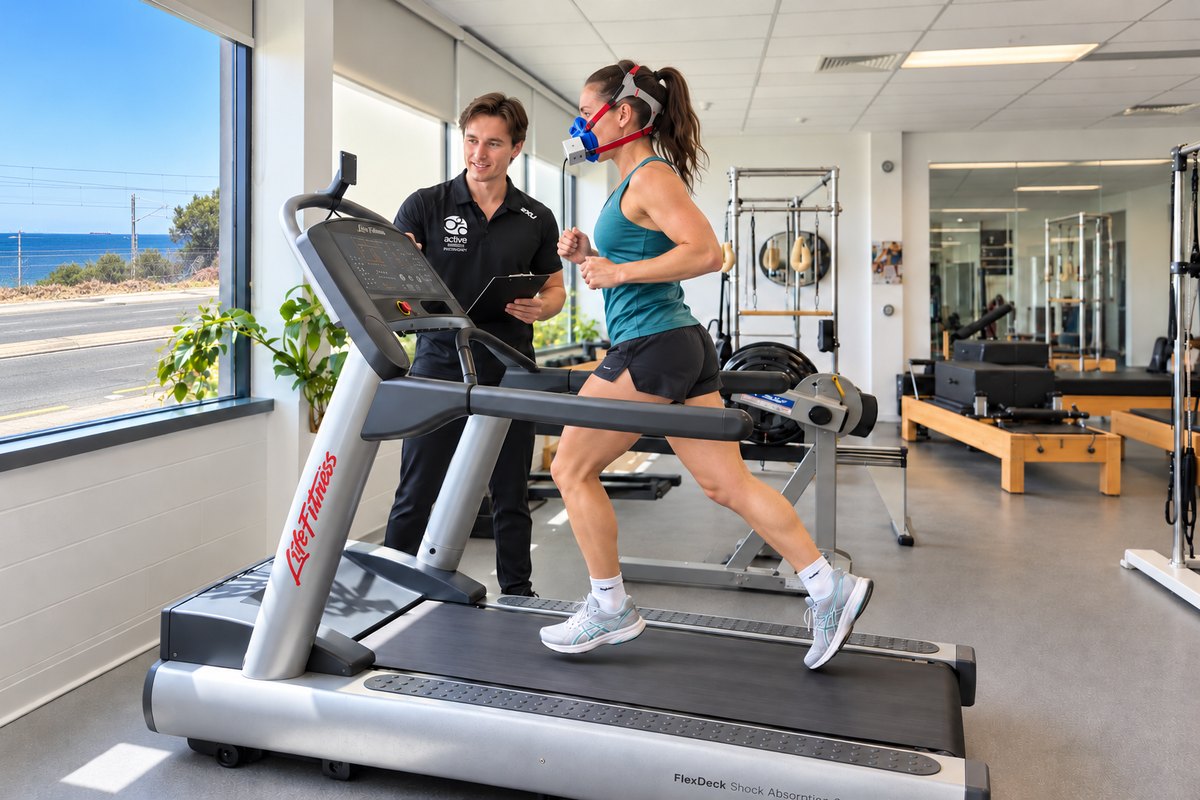
Performance athletes and active clients: our laboratory VO₂ Max test measures your true aerobic ceiling and builds your training zones from real data. See VO₂ Max Testing →
The gold-standard measure of cardiorespiratory fitness, and one of the strongest known predictors of long-term health. A supervised graded exercise test with full gas analysis gives you a precise baseline, accurate training zones, and a number you can genuinely move. Full details & booking →
A graded clinical test that stops at your peak, suitable for the general population including people with health conditions, giving you your own heart-rate training zones under clinical supervision. It also anchors our cardiac exercise physiology program, with results reported back to your cardiologist and GP.
A simple breathing test that measures how your body produces and uses energy at rest. Real data on your metabolism (resting energy use, fuel utilisation) replaces the estimates most weight management and health programs are built on.
Identifies the exercise intensities where your physiology actually changes gear. Essential for endurance athletes building precise training zones, and valuable for anyone who wants training intensity set by measurement rather than a formula.
Quantified movement analysis that turns “your squat looks a bit off” into measurable joint angles, ranges and compensations across the shoulders, hips, ankles, thoracic spine and trunk, with single-leg balance and reach: screening you can track over time, not a one-off opinion. Around 45 minutes, $185, with any of our exercise physiologists.
Rich's running analysis replay, slowed to a quarter speed. Shared with his permission.
Your walking or running, filmed from the side and the front and reviewed in slow motion. We measure cadence, step and stride length, stance and swing time, foot clearance, left and right symmetry and joint angles at the key moments of each stride, then name the functional limitation behind the numbers: a short push-off from a weak posterior chain, a hip that drops on one side, a foot that barely clears the ground. Functional analysis only; anything that suggests a medical cause is referred to your doctor. Around 45 minutes, $185, assessed by Caitlin Hunt or Kelly.
Dual force plates measure strength, power, balance and left and right asymmetry with laboratory precision. Used through rehabilitation, return-to-sport decisions, falls-risk assessment and performance training.
Objective strength measurement across key muscle groups: baseline, benchmark, and re-test. Because “feeling stronger” is good, and being measurably stronger is better.
InBody scanning gives an estimate of muscle mass, fat mass and hydration. It is non-invasive, repeatable, and best used to track your trends under consistent conditions across your program.
Lung function testing that measures how much air you can move and how fast, useful for respiratory screening, pre-exercise safety, and establishing a clear baseline.
A test result is only useful if it changes what you do on the floor. Every assessment at North Fremantle works through the same sheet: your predicted working loads on the push, pull, hinge and squat patterns, your InBody segmental muscle balance, your movement screen and, where it matters, your walking or running analysis. Together they show where the strength and the movement pattern are sound and where one side, one joint or one phase of the stride is doing less than it should.
From those findings your exercise physiologist prescribes your swap exercises: the specific lifts and drills that target the weakness we found, written into your program so that in a class, in open gym or in a 1:1 session you are building strength exactly where the data says it is missing. A weak push-off becomes posterior chain work. A hip that drops on single-leg stance becomes glute and pelvic control under load. A calf that fatigues in 9 reps on one side and 26 on the other becomes a calf program sequenced to the weaker leg. You keep loading the movements you came for, and the swap exercises make sure the chassis can carry the load.
Every number sits in your test tracker, and the same tests are repeated at 12 weeks under the same conditions, so the re-test shows whether the asymmetry closed, the clearance improved and the strength arrived. Change is measured, not assumed, and your GP or specialist receives the findings that matter to your care.
Start with the assessment that matches your goal, or refer a patient for objective baseline data.
