In one fasted hour you get five numbers about how your body makes and uses energy at rest, and a body composition scan to read them against. Here is what each one means and what we do with it.
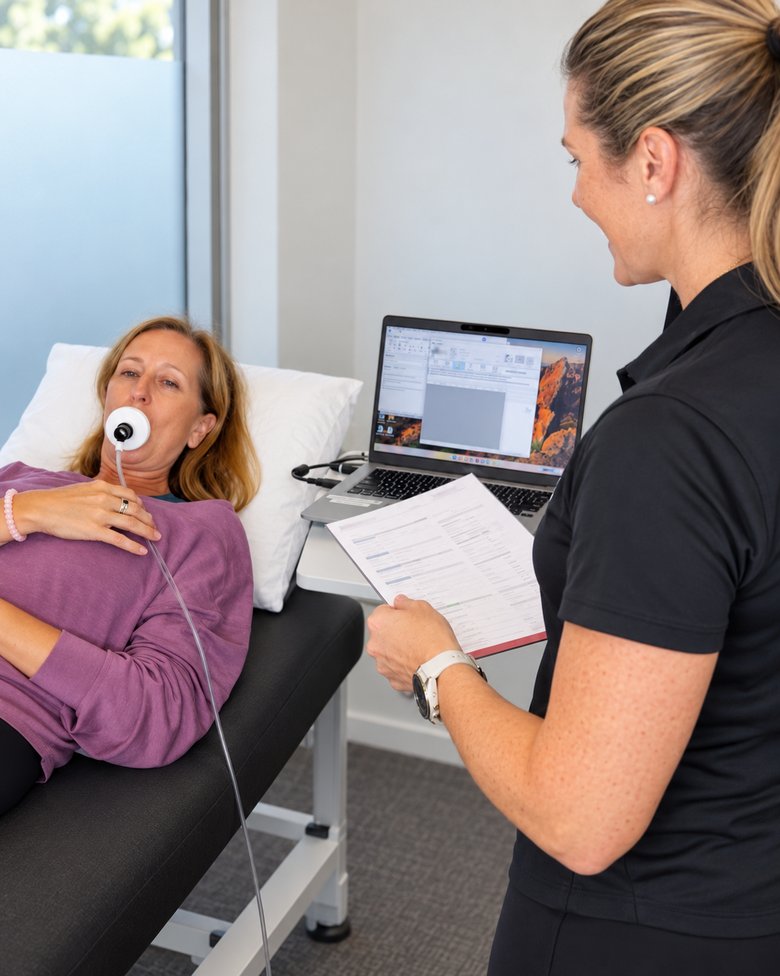
Most people who book a metabolic test have tried the obvious things and are tired of guessing. The appointment is built to replace guessing with measurement. It takes about 60 minutes at our North Fremantle clinic, costs $185, and produces two things: an InBody body composition scan, and a resting metabolic profile from the ECAL analyser. Your exercise physiologist explains both in plain English and sends a report to your GP or specialist.
You arrive having fasted for at least 4 hours (12 is better for a full interpretation), with no caffeine or nicotine beforehand, no alcohol for 24 hours and no exercise for 12 hours, and a little early so you are settled. We measure your height, run the InBody scan, and enter your lean mass into the ECAL software so the result is calculated for your body, not an average one. Then you sit or recline, put in a mouthpiece and nose clip, and breathe normally for 3 to 5 minutes while the analyser measures the oxygen you take in and the carbon dioxide you breathe out. If your breathing rate or volume drifts outside the normal range the test is repeated, because a relaxed, normal breath is what makes the numbers trustworthy.
Resting metabolic rate. The energy, in kilocalories, your body uses at rest and in light activity each day. For most people it is around 80 per cent of total daily energy use, and the normal range depends on your age, sex, weight and muscle mass. A low result points to under-fuelling, low muscle mass or shallow breathing on the day; a high result can simply mean you were not settled, or that you carry more muscle. The number sets a realistic energy baseline rather than one from a formula.
Fat burning. The share of your resting energy coming from fat. The normal range is 48 to 83 per cent, and higher is generally better at rest. A sustained low fat-burning result is associated with higher risk of insulin resistance, metabolic syndrome and related conditions, and it is the number that most often changes with training and with what you eat.
Glucose availability. The share coming from carbohydrate, normally 17 to 53 per cent. A high result at rest usually means your body is running on recent carbohydrate rather than stored fat, and above about 20 per cent the surplus is being stored.
Respiratory quotient. The ratio behind the two numbers above, normally 0.75 to 0.85. Your exercise physiologist checks the oxygen and carbon dioxide readings underneath it, because a normal-looking ratio can hide an abnormal reading on either side.
Efficiency. How well your cells take up the oxygen you breathe, read from the oxygen left in your expired breath. A normal result is 16 to 17 per cent and lower is better. Poor efficiency is a flag that something is limiting energy production, which can be inflammation, poor sleep, low iron, smoking, medication or simply inactivity, and it is one of the reasons we talk to your GP.
The InBody scan estimates skeletal muscle mass, fat mass and visceral fat area, by body segment. It is an estimate, which is why we read it as a trend over time rather than a verdict on one day. The two figures we watch most are muscle mass, because the scales hide muscle loss, and visceral fat area, where under 100 square centimetres is considered healthy. When a precise measure is needed, DEXA is arranged through your GP or Signal Health.
ECAL measures resting metabolic rate and resting fuel use. It does not measure insulin sensitivity, thyroid function, hormone levels or fuel use during exercise. Blood tests, hormone investigations and diagnosis sit with your GP; we record and report, and your doctor interprets. If your results and symptoms point to something that needs investigating, we say so in the report.
Your results decide the prescription. A low fat-burning result and a high glucose result call for steady, lower-intensity aerobic work and resistance training before any high-intensity training, along with changes to meal timing that we talk through using the handouts you take home. A low resting metabolic rate calls for resistance training first, because muscle is what lifts it. If your doctor has prescribed a GLP-1 medication, a significant share of the weight lost can come from muscle, so the program is dosed to protect it. Your exercise physiologist sets a review date, and the full profile is re-tested so you can see the trend rather than a single number.
Resting metabolic profile delivered on the ECAL indirect calorimeter. Body composition by InBody 570. Individual results vary. This article is general information, not individual advice.
