Longevity advice is everywhere in Perth. Measurement is rare. Here is what we test, why those tests and not others, and what happens after the numbers come back.
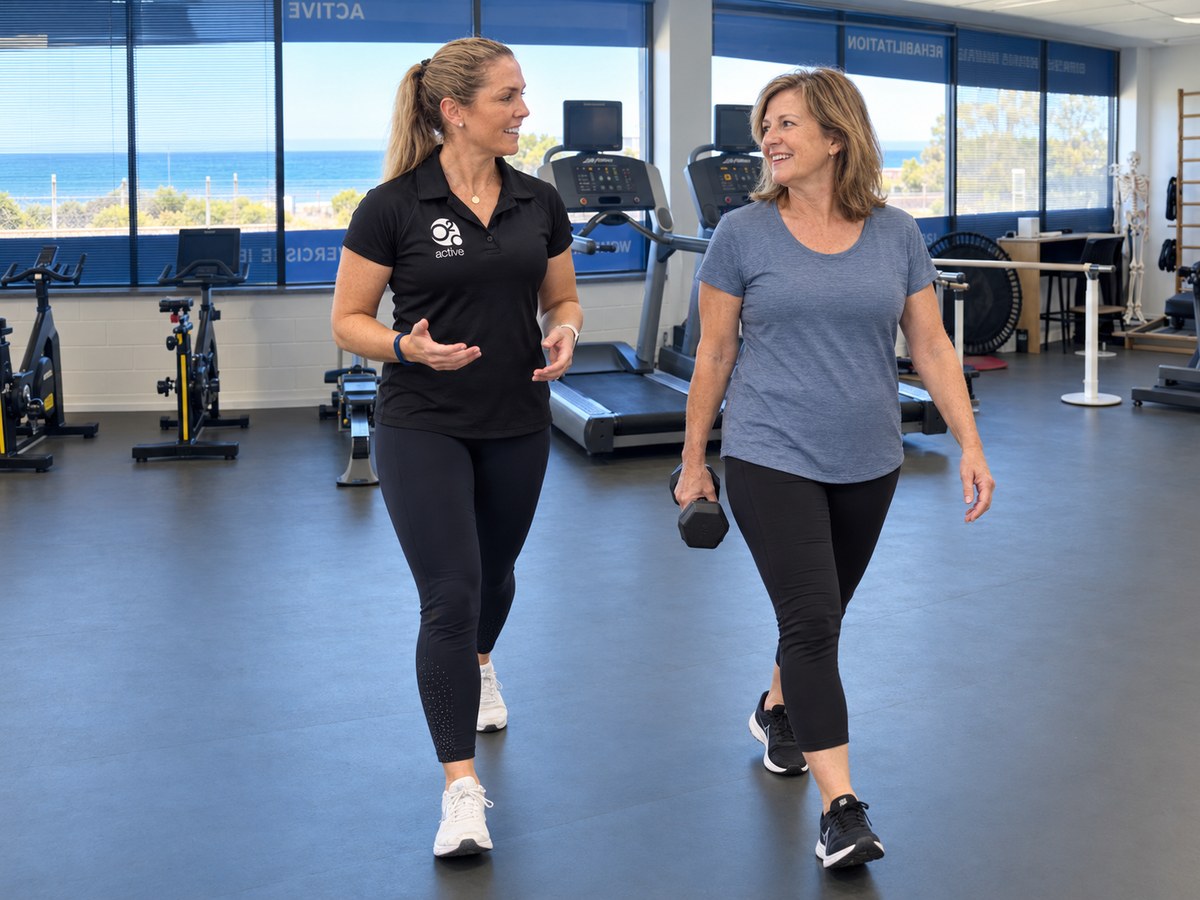
Search for longevity in Perth and you will find supplements, scans and programs that promise a longer life. Most of them skip the part that matters: measuring where you actually stand, and then changing the numbers that are known to change how well you age. This article sets out how we do that at O2 Active, and why the exercise physiology side of longevity care is built on a handful of tests rather than a long menu.
Longevity care starts with a longevity consult and tailored biomarker and medical testing based on your health history and screening. That is the medical baseline: the blood, cardiovascular, metabolic and hormonal investigations a doctor selects and interprets, through your own GP or through our Longevity Care partner, Signal Health. O2 Active does not do that part, and we do not pretend to. What we bring is the exercise physiology that acts on it, delivered in clinic at North Fremantle. If you want the complete Longevity Care program, it is booked through Signal Health. If your GP is already managing your medical care, or you only want the exercise testing and program, book an Initial Assessment with us directly and we coordinate with your GP by letter.
Our clinical manual limits longevity testing to measures with evidence behind them as markers of long-term health, each with its own re-test interval. Four stand out.
Cardiorespiratory fitness. We measure it with a graded, symptom-limited VO₂ Peak test, with ECG monitoring for adults over 50 or anyone with cardiovascular risk markers. In a large study of adults undergoing exercise testing, the least fit had around five times the risk of death from any cause compared with the fittest, a larger difference than that associated with coronary artery disease, diabetes or smoking (Mandsager et al., JAMA Network Open, 2018). This is an association from observational data, not a guarantee, but it is one of the strongest in the field, and fitness is modifiable at any age.
Grip strength. Three trials on each hand on a calibrated dynamometer, best of three, compared with age and sex norms and with the two sides compared for asymmetry. Across 139,691 adults in the PURE study, every 5 kg lower grip strength was associated with a 16% higher risk of death from any cause (Leong et al., Lancet, 2015). Grip is not the muscle we train for its own sake. It is a ten-second window onto whole-body strength.
Function and balance. A 30-second sit-to-stand from a standard chair with arms folded, timed up and go, gait speed and balance. Simple tests, well normed, and the ones that start to matter more with every decade because they predict independence. Over 75 they form our frailty screen.
Body composition and resting metabolism. An InBody scan gives an estimate of skeletal muscle mass by segment and visceral fat area, which we read as a trend under consistent conditions rather than as a single number. A visceral fat area under 100 cm² is considered healthy. An ECAL test measures your resting metabolic rate and the mix of fat and carbohydrate your body burns at rest, nothing more, and it shapes how we build your aerobic base. Where a precise bone density or body composition measure is needed, DEXA is arranged through Signal Health or your GP.
A result on its own changes nothing. From your baseline we write a program your exercise physiologist supervises: progressive strength work on the hinge, squat, push and pull patterns at loads prescribed from sub-maximal testing, an aerobic base built at the intensity your test shows, and balance and power work scaled to your capacity. You train with us 1:1, in EP Pairs or in a supervised class, and we re-test at 12 weeks so the change is measured rather than assumed. Your results go back to your longevity GP and your own GP by letter, so the medical and exercise sides of your care read from the same numbers.
Most of the people who come to us for longevity care in Perth are in their 40s to 70s. Some are fit and want to defend it through the decades. Many have not trained in years and want to keep doing the physical things they value, from work and sport to grandchildren and travel, for as long as possible. The program is built from your own baseline, whatever it is. Individual results vary.
Tests, thresholds and re-test intervals from the O2 Active clinical manual v1.2: cardiorespiratory testing (symptom-limited VO₂ Peak), grip strength, 30-second sit-to-stand and functional testing, InBody body composition and ECAL resting metabolic testing. Evidence cited as associations. Longevity care is booked through Signal Health; no rebate is claimed for it.
