Three squeezes of a hand dynamometer tell us more about your next decade than most people expect. Here is what the number means, the thresholds we use, and what changes it.
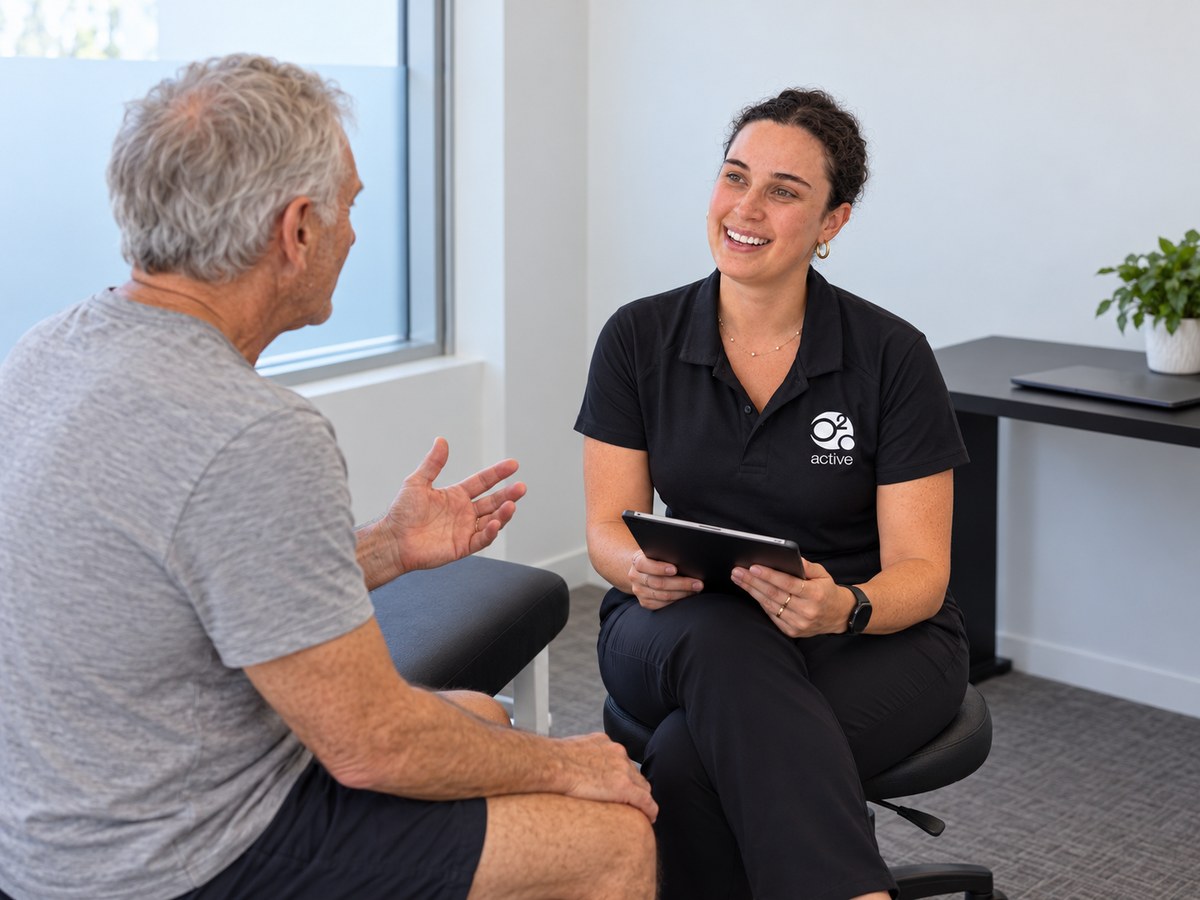
Every Initial Assessment at O2 Active includes a grip strength test, whether you have come in for a knee, a heart or a weight goal. It takes under a minute and it is one of the strongest single signals we record. Low grip strength is strongly associated with muscle weakness, falls, frailty, complications after surgery and death from any cause, and in a large international study it tracked mortality more closely than blood pressure did. It is also one of the most modifiable numbers on your report.
You squeeze a calibrated handheld dynamometer (we use the VALD DynaMo Pro) as hard as you can for 3 to 5 seconds, three times on each hand, and we record the best of the three. We do not test within 6 weeks of hand, wrist or upper limb surgery, and we note anything that could lower the score on the day, such as arthritis in the fingers. The test is repeated at every re-test so the trend is as reliable as the number.
We read grip against the European Working Group thresholds for sarcopenia, the age-related loss of muscle and strength. Below 27 kilograms for men and below 16 kilograms for women is the flag. A result under the threshold, combined with a low appendicular lean mass index on the InBody scan, meets the criteria for sarcopenia screening and changes how we build your program. Over 75, or at any age with other frailty markers, grip sits inside a formal frailty screen alongside gait speed, sit-to-stand, the timed up-and-go and balance.
Grip is not trained by squeezing things. It is a window on whole-body muscle, so a low result calls for progressive resistance training across the main patterns: hinge, squat, push, pull and carry, loaded in steps and supervised. For most people in their 50s, 60s and 70s that means two to three sessions a week, 1:1, in EP Pairs or in a Strength & Osteo class at North Fremantle or Swanbourne, with the load increased as technique allows. Where surgery is planned, a low grip result is also a reason to start training before the operation rather than after it.
Your grip score, the sarcopenia screen and the rest of your baseline go into your report and, where a finding matters, to your GP. We re-test at 12 weeks. Grip responds slowly compared with leg strength, so the number we are looking for at the first re-test is a steady rise rather than a jump; the larger changes show up in your sit-to-stand and your working loads first.
Thresholds: EWGSOP2 sarcopenia criteria. Evidence: Leong et al., The Lancet, 2015 (PURE study). Observational findings are stated as associations. Individual results vary.
